I recently attended the workshop production of three one-act plays. Only one was good, despite some stellar actors, but that's not unexpected. It's similar to the success batting average of the much more fully produced plays I see around town.
But as I took my folding chair in the first cramped studio, I was totally distracted - by the sight of one of my fellow audience members.
She was tall and striking-looking, but also very familiar, in a way that instantly engendered feelings of sympathy, almost sadness. But why? From where?
I knew this much: she was an actress, and that whatever I had seen her in, she had been new to me, which is always cool, when you can just accept a performance on face value without the baggage of having seen them in something else.
But it also means it might take a while for me to remember from where, even longer to recall a name. (Thank God for IMDB and IBDB; I see so many plays, movies, and TV shows it can take me a couple of different performances for even the face to stick.)
Met Museumgoer looking at Felix Vallotton's 'The White and the Black" (1913)
How do we keep it together during times of chaos? A friend recently posted on Facebook:
"Happy to say I'm taking some time off to get my head/body together (right now they're in different time zones) but I had to cancel my plans for a walk-on-deserted-beaches sojourn because of family responsibilities...I wonder if I could run a few possibilities by you wonderful people?"
His ideas ran the gamut from Meditation and Psychedelics, to Electroshock and Gastric Bypass, to Public Service. (Already attempted: lying in bed all day with the shades down reading a long book about targeted killings by the Mossad.) He asked if we had any other suggestions. It was half-kidding, but, in days like these, half-not. Many of my friends and I feel worried about the sky falling. (Indeed, tragically, just before Christmas a woman was killed by a piece of a building near Times Square.)
Reading my friend's post, I realized I hadn't written on this blog in more than a year - since before the midterms! The last one I felt compelled to register had been about the bomb scare at work.
So what have I been doing since? Immersing myself in what I'm learning to think of as the Culture Cure.
First and foremost, I continued writing (and rewriting) a play - my first - about George McGovern, Thomas Eagleton, and McGovern's daughter, around the issue of mental health, the Presidency, and the conflict between public and private lives.
Director Adrienne Campbell-Holt's stellar cast: (Lucy Consagra, stage directions) Susannah Perkins, Juliana Canfield, Greg Hildreth, Zoe Winters, Greg Keller, CJ Wilson, Susie Pourfar, Peter Grosz, James Udom, Adam Harrington
Audible sponsored a developmental reading at the Minetta Lane Theater with an amazing director and cast that helped my next revise. And also continued my hard-won wisdom on the realities of the theater marketplace. Meanwhile,
Central Park evacuation site, 11 am, panorama fail by dying phone.
It's not every day you get asked by two different people if you can speak to Israeli media about your day at work. (I declined.) Or you feel obliged to "mark yourself safe" on Facebook. And then learn that even after a pipe bomb had been sent to Hillary Clinton (among other prominent Dems), the President is still being greeted at his umpteenth rally with chants of "lock her up."
But we are living in weird times.
It was already one of those days that people who believe in such things describe as "Mercury in Retrograde." At 7 a.m. I had subwayed uptown to swim at my neighborhood rec center, only to learn the lifeguard was stuck in traffic and the pool could not open. So instead I bought groceries, and, beladen entering my apartment building door, apparently dropped my cell phone. When I called it, I discovered it had been found and retrieved by a good Samaritan who'd fetched a dog from my building to bring to her grooming place around the corner. I got it back and gave her a tip.
So by the time I got to work at CNN I was already a little rattled. Up in the cafeteria, I looked in vain for signs of fall foliage.
Cafeteria view. Trump Hotel on left. (Gold statue = evacuation site.)
Guess we picked the wrong day to help others.
Instead, I saw volunteers as part of today's "Turner Volunteer Day" writing thank you cards to people serving in the Armed Forces. Having terrible handwriting, I had chosen instead to sign up for a 3pm shift of "Medshare," in which I was going to:
Sort, pack, assemble, and box Clean Birthing Kits for
pregnant women and newborns in need who live in communities worldwide where
birth often takes place outside of a medical facility.
Instead, at 10:09 am, the fire alarm started going off. I grabbed my phone, wallet, keys and jacket, and, bizarrely, a water bottle. But not my bag with my external cellphone battery.
Unfunnily enough, we'd had a mandatory "active shooter" training a few weeks ago, where we learned where the staircase exits were, how to not get isolated in an area with no escape, etc. But when the voice came over the speaker
In his first 500+ days in office, the President's war against disrespect for the National Anthem has become one of his reliable go-to chestnuts, a greatest hit with a dog whistle chorus that he sings with panache to keep the crowd in his pocket.
But today he took it to another level, by claiming the song is actually good. And I couldn't help thinking comedian Albert Brooks had it right 45 years ago when he did a routine suggesting we needed a national contest to pick a new one, and how that might go.
Since Trump himself is the master of reality TV, maybe it's time to revisit the idea.
After the President learned that only a handful of the Super Bowl Champ Philadelphia Eagles were going to show up for his White House celebration, he disinvited them, claiming (in a third-personese statement) to do so because the players disrespected the Star-Spangled Banner:
“They disagree with their President because he insists that they proudly stand for the National Anthem, hand on heart, in honor of the great men and women of our military and the people of our country.”
Trump rejiggered the ceremony to be a celebration of America, and his early morning tweets began praising the Anthem itself as a wonderful/great piece of music.
7:08 AM:
13 minutes later:
But as Trump supporter Roseanne might be among the first to attest, the National Anthem is a difficult thing to sing, both clunky and wide-ranging. And though the lyrics were written by Francis Scott Key during the War of 1812 to an old oft-used tune, it wasn't even crowned our Anthem till 1931, and was toyed with endlessly over the years. As the NY Times has reported,
In the 19th century, the tune was regularly refashioned with lyrics to be, alternately, a rallying cry for abolitionists (“Oh, say do you hear, at the dawn’s early light, The shrieks of those bondmen, whose blood is now streaming”) or a temperance-movement indictment of alcohol (“Oh! who has not seen by the dawn’s early light, Some poor bloated drunkard to his home weakly reeling”).
So in 1973, when Brooks, then 26, did a routine suggesting America rethink the tune - it had only been in its esteemed slot for 42 of America's 197 years. (And Nixon was one year shy of resigning over Watergate.)
(When I wrote a career tribute to Brooks seven years ago, I embedded a video of him performing it live that since has been removed from YouTube in America due to copyright reasons, so you're going to have to listen to it. Pretend it's a podcast!)
Prophetically for today's climate, Brooks begins his routine - recorded live at L.A.'s Troubadour - by saying "The National Anthem - What happened? Oh, someone got up! No, no. You don't have to stand."
Then Brooks declares the anthem has to be rewritten "very soon"
Both the first and most recent times I saw Bruce Springsteen - almost 40 years apart - I sat left of center.
Most everything else had changed. When we started this dance, I was a high school senior; now he's a senior citizen (and I'm still only 12 years younger). We both had kids (though mine seem more interested in his music than his). He moved his act uptown from the scrungy Palladium (RIP) to a posh Broadway theater, along the way putting a wrecking ball to the original Giants Stadium.
And the face value of my ticket went up from $8.50 (though my scrawl in my scrapbook indicates I actually paid a scalper price, $32) -- to $400. The Times, They Are Ka-Chinging.
The Ties That Bind (and cost big bucks)
I've seen Bruce live maybe 3 dozen times - fewer, to be sure, than the hardcore diehards, but still, more than any other musician, in venues large and small, from acoustic to full strings and horn section - even when he sacrilegiously disbanded the E street band for a tour ("Shayne Fontayne on guitar!" Really?).
I had his poster in my college dorm room, own more Bruce bootlegs than all other artists combined, and sprang for most of his recent overpriced boxed-set-remixed-reissues (even though I will probably never slog my way through all the peripherals, right).
Poster I had in college
But as his core E Street band members have started to die off (Clarence Clemons, Danny Federici) and the others - unlike Bruce - have started to show their age from the wear and tear of his marathon shows, I started to feel my Springsteen concertgoing experience becoming something of a replica of the real thing. Not Vegas, not a tribute band, but just less freewheeling. He was still putting out the energy and spirit on stage (a mutual high that he admitted in interviews he was addicted to - as were we all), but I was missing the unpolished spontaneity and quirky personal discursiveness that had helped attract this sheltered suburban kid to his wild-eyed yearning romanticism.
Well, Bruce has been also thinking about (and working on) himself - including publicly, first for my friend Peter Ames Carlin's bio Bruce, in which Springsteen not only was unusually open about his private demons, but allowed those in his life to speak without NDA restraints; then for his autobiography, Born to Run (recommended in audio form).
I had long joked that as Bruce hit his 60s, instead of exhaustingly touring worldwife, he should just take up residency and just play a month a year at an arena in Jersey and his fan base would make pilgrimages to see him. (In recent years, Billy Joel and Jerry Seinfeld have both done versions of this.) Now Bruce has hit on a plan that satisfies his musical and introspective urges, and one that leaves the E Street Band off the hook: this solo Broadway run, five shows a week, sold by lottery trying to thwart scalpers (as if), opened October 3, 2017 for "8 weeks only" but has been extended three times (as of this writing) to December 15, 2018.
15 months only! (so far)
It's not a rock and roll show, though he does play some of his biggest hits on piano and guitar. Instead, hearing Bruce's elegiac travelogue through his life and career, I found myself newly moved, as he described looking back wistfully at the time when his life was ahead of him like a blank page. He spent as much time talking as he did singing, and he candidly admitted the man who wrote "Racing in the Streets" was very late to even learning to drive, and that the rebel who wrote "Born to Run" and swore to escape his "death trap" hometown, now resides a stone's throw away. He brought out his wife, Patti Scialfa, for a couple of songs. He revisited the meaning of his friendship with Clemons.
As I sat there, I also realized that, when you spend 40 years in the company of a sentient artist, you accumulate a lifetime of memories - even if the relationship is one-sided (I have only met and spoken to him once - more on that below).
Just as if you live in New York long enough, nearly every block and corner of Central Park you walk in holds a special memory - if you see enough Bruce, it becomes its own narrative of your life, with the inevitable tragedy, comedy, and every now and then, a glimpse of salvation.
I know everybody's got their Bruce stories, but these are mine.
Since most of them predate cell phone cameras, this is my scrapbook.
GROWIN' UP
1977, sophomore year. I'm at Steve Hertz's house. He's a senior and, LP's spread everywhere, has been playing deejay to help upgrade my musical taste from the mainstream I'd embraced so far (Beatles, Stones, Elton John, Stevie Wonder, Eagles, Yes, Fleetwood Mac, Queen. ELO, ELP).
Steve puts on a song: "You know this?"
Of course.
"This is the original. Isn't it so much better?"
The song is "Blinded By The Light."
I only knew the version I'd heard on the radio, by Manfred Mann's Earth Band (in which the confused Brits sing "revved up like a douche" instead of "deuce").
I dunno -- a little tinny sounding? I am still not sure. (!)
Eventually Steve wears me down. And when he graduates, a senior in the next class, Eric Alterman, imparts an even bigger Bruce fandom knowledge (as well as inculcating me into the Clash and Elvis Costello). He would later write a fan's appreciation book.
Soon I am tuning in to Springsteen's live radio broadcasts and taping them on my cassette deck,
Think today's deep-dish partisan divide is unprecedented? Just listen to episode 5 of Slate's Slow Burn, its deep-dive story of Watergate. It provides helpful context for the period we are living in now.
If you don't think supporters of a sitting President were ever this die-hard loyal despite all rational reasons not to be. If you think it's only the current bitter climate in which a party seems to be willing to self-protect at any price.
But most of all if you think that Devin Nunes' accusatory behavior - and apparent marching orders from the White House is some kind of aberrational anomaly.
In case you don't have the time to sit through the podcast, I will "spoil" some of it here, because it is historically important. And fascinating.
The most amazing nugget I took away from the episode was that the narrative I had always believed - that John Dean had come clean about Nixon's culpability, and then was buttressed when a White House staffer revealed that everything in the White House had been taped, was some kind of 1-2 punch of The Truth Tellers routing out the Bad Guys.
In fact, the only reason the tapes ever got exposed is much more happenstance - and only occurred because the Nixon White House was trying so hard to obliterate Dean's credibility that it overreached and unwittingly exposed its own secret.
(Not unlike the recent Nunes Memo which unwittingly undermined its own argument. Trying to assert that the Russia probe was bogus because it was launched by the Steele Dossier, it also included the fact that what really launched it was George Papadapoulos's earlier loose lips about Russia providing dirt on Hillary.)
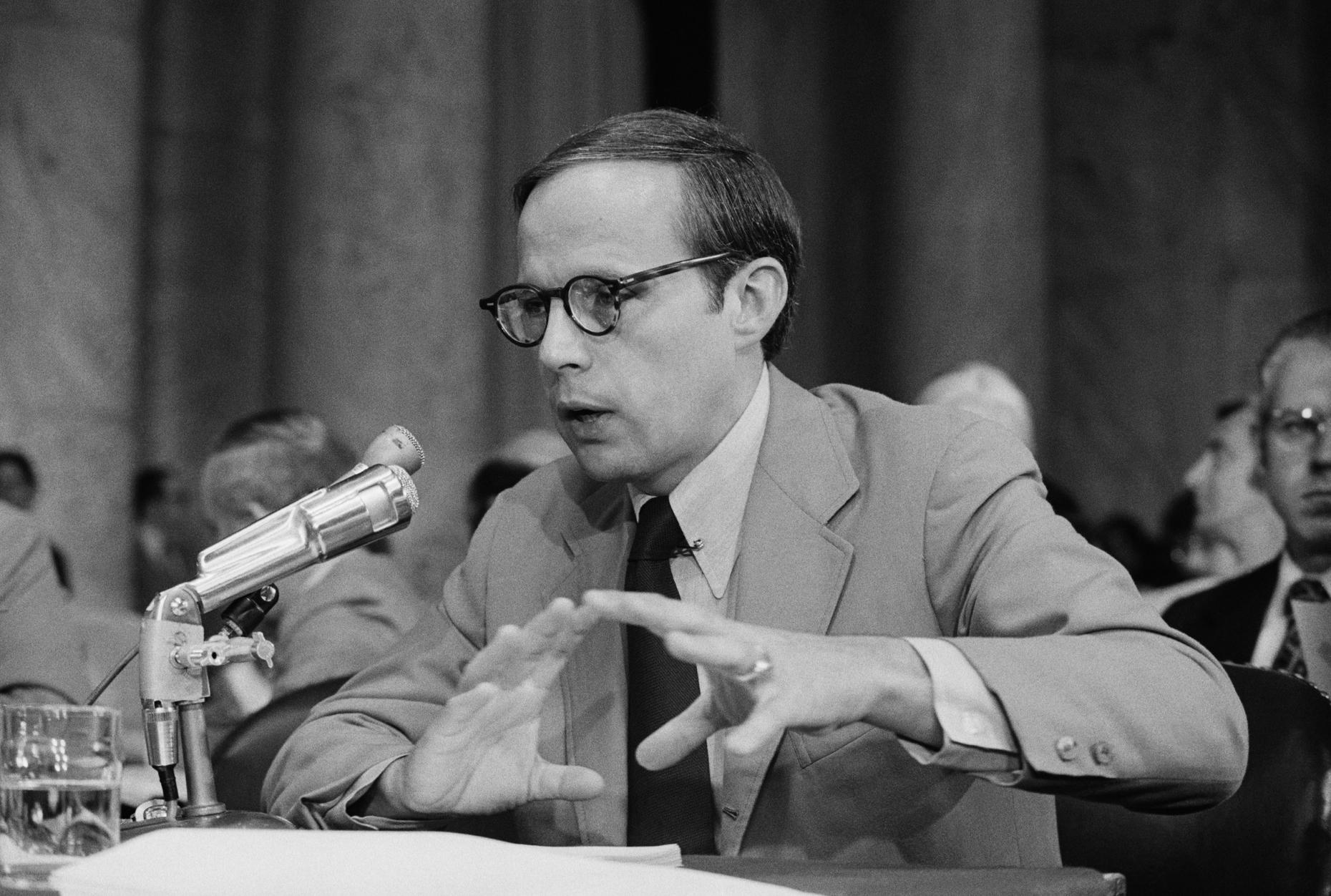
John Dean testifies, 1973
White House attorney Dean wanted to testify in full to Democrats before any Republicans heard what he had to say, because he worried the White House would immediately hear his testimony from its compatriots mount a counter narrative. And it turns out he was right. Because as soon as he testified, the committee was given transcripts of conversations that Dean had in the White House to undermine his story.
But a savvy investigator (of course who, is, again, a partisan squabble, even today) was like, wait, why do you have these transcripts? Does someone have a really good memory? Or are there some kind of tapes we don't know about?
My memory of all this was that the White House guy who helped install the recording equipment in 1971, Alexander Butterfield, had heroically decided to come clean like Dean.
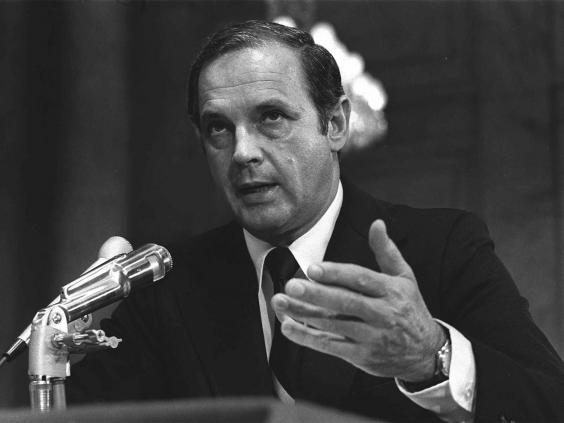
Butterfield testifying
That turns out not to be the case. In fact, when interviewed at age 86 he told the Washington Post in 2012, that he was willing to remain vague unless he was asked specifically about the tapes, and he doesn't like being thought of as a snitch.
“Frankly, I don’t like being known as the man who revealed the existence of the tapes. It makes it appear that I ran full tilt to the Watergate committee and told them eagerly and breathlessly the very information that Nixon considered top secret. That was not the case. I was facing a true dilemma: I wanted very much to respect Nixon’s wishes and at the same time to be cooperative and forthright with the congressional investigators. The wording of their questions meant everything to me. And when Don Sanders, the deputy minority counsel . . . asked the $64,000 question, clearly and directly, I felt I had no choice but to respond in like manner.”
Why wouldn't he want to be known that way? Because of loyalty?
We are very lucky the overreach happened, and that someone thought to ask the question, or it may never have come out.
And without those tapes (which, as David Frost pointedly asked, why didn't Nixon destroy them?) Nixon would have continued to maintain his innocence.
And he had many True Believers.
As I write this, there's news from CNN and the NYT that Steve Bannon is refusing to speak to the House committee despite a subpoena. And one can't help wonder if he knows the John Dean playbook - that he wants to save the truth for Mueller and not give away what he knows to those who will run it immediately back to the White House.
Maybe that's not why this is happening. We may not learn the full truth for another 40 years. That's a slow burn indeed.
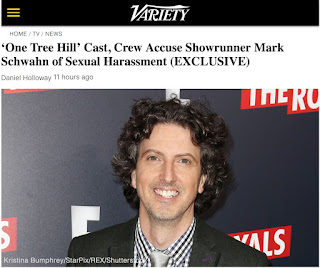
This summer, I was tickled to read the oral history of one of the craziest episodes in TV history -- in which a dog who's digested marijuana makes off with the heart being brought into a hospital for a character's transplant. Because I had been part of that creative process, as a story editor on season 6 of One Tree Hill. In fact I was kinda sad I hadn't been interviewed. I would have told the reporter the episode probably contributed to me not being asked back the following season, because when the creator, Mark Schwahn, pitched the dog-heart scenario, I blurted out "You can't do that!" Being told "no" was a trigger for Schwahn, who often reminded us he'd grown up in a trailer park and, with no showbiz connections, created the young-people smalltown soap opera and kept it on the air despite getting no respect from critics -- or even his own network. Every season he concocted a finale that could double as a series finale, because he was never told in advance that the show would be renewed. Six seasons in, he bristled that he was still arguing with the higher-ups over his casting choices. In fact even though the show was produced by Warner Brothers, instead of being on the legendary studio lot the offices were on the lower-rent "Ranch" down the street, in a grim little trailer (a weird ironic twist given how far he'd come from his origins).
Perhaps in retaliation, he made so many out-there nutty plot choices that the room had developed the catchphrase, "What just happened?" to remind us to think outside the box. While critics may have looked down on it, it outlasted, say, The West Wing by two seasons. So: when I blurted out "You can't," Schwahn bellowed back "Handelman! Never say 'can't'!" He was the king, and I was the peon. We both knew I was lucky to be there-- in fact he had rescued me from the scrap heap. He'd interviewed me for season 5 and not chosen me, and then my agents had dropped me. So a year later when they called to say he was looking for me, I landed the gig with no agents at all. So it was very hard to go up against him. And most of the other writers in the room were in similar positions --